Hi Mike,
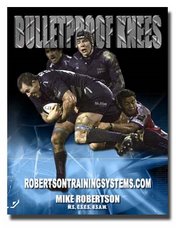
I've just finished reading the Bulletproof Knees manual and I thought it was a fantastic read! It's definitely a resource I'll be using to help myself and anyone I know with knee problems (and hopefully prevent some people even having them!)
I do have a few questions from reading the manual I was hoping you would be able to help with:
1) On the double and single leg jump progressions, is it a good progression to go from wearing trainers to barefoot? I know there has been a shift towards doing warm ups and where possible train barefoot, I just wasn't sure whether it would be too much on the joints or not.
MR: While warm-ups and such are great choices for barefoot training, I really don't advocate taking this over into ballistic/high shock absorption movements like jumps and sprints. Most people's feet are far too weak to effectively absorb the shock, and while their knees might feel great they'll end up with some sort of lower extremity injury. Not good!
2) You mention that if someone suffers from compression or tracking issues they shouldn't wear the knee sleeves. Could you expand on why this is? If someone does suffer, are there any alternatives to wearing knee sleeves?
MR: People that have compression/tracking issues generally like the warmth a knee sleeve provides, but if they're too tight they only create more compression/tracking issues at the patello-femoral joint.
It's not so much that it's contraindicated, but I would definitely make sure they are loose and not furthering altering the normal biomechanics of the knee.
3) I like the idea of using the credit card to remove fluid, when you are scraping the card up the leg, do you just go around the whole knee or if you have a specific area that aches, just scrape over that area?
MR: I will actually start at the lower exremity, work my way up to the knee, and the all the way up into the thigh. If your leg is elevated and straight so that your foot is above your hip, think about working from the upper most to lower most portions.
4) Final question :-). I don't currently have any bands to be able to do the band stomps. I am currently looking to get some ironwoody ones, do you think they would be ok to do the band stomps with?
Thank you very much for your help!
Regards,
Jon
MR: I don't have any experience with the Iron Woody bands; every band I've ever purchased has been of the Topper(?) variety which can be purchased at Elite Fitness Systems (www.elitefts.com).
Thanks for the questions and good luck!
MR
Showing posts with label Knees. Show all posts
Showing posts with label Knees. Show all posts
Tuesday, April 29, 2008

Friday, July 27, 2007
Squats and Your IT Band
I've been having some ITB pain. From what I read squatting makes this worse
- is there something I could subsititute for squats that wouldn't irritate
it? How do I prevent this problem in the future?
It's a little bit more complicated than just "not squatting" - there's
probably some underlying issues that need to be addressed.
Firstly, I'm not sure what you're doing for "core" training, but check out
my "Core Training for Smart Folks" article on T-Nation. If you are going to
do core exercises, start with those.
Next, since you're running you need to focus on stretching/foam rolling your
hip flexors, quads, TFL and ITB as often as possible. These are the areas
that get short/stiff due to running and most weight training programs; this
will pull your pelvis into anterior tilt, and, well, it gets messy from
there. Just trust me when I say it leads to a cascade of events and
eventually you're screwed up in all three planes of movement! ;)
Beyond that, focus on a lot of gluteal work - glute bridges, long-stride
lunges, single-leg RDL's, pull-throughs, etc. Generally when people have
ITB issues there's an imbalance in strength between the TFL and the glute
max; balance what's going on at the hip and the ITB issues will typically
follow suit.
Mike Robertson
Wednesday, June 27, 2007
Meniscus Repair or Partial Meniscectomy
Mike,
I just wanted to let you know how much I have enjoyed the program Bulletproof Knees. I feel more confident now dealing with the many clients and the ever present knee pain. Of course that's after the MRI and the all clear from their Doctors.
However, I do have a question for you concerning meniscus repair. I have two clients who have had the surgery and were told not only no squatting or step-ups, but not even the basic quad stretch. On page 61 you made it clear about this. I would appreciate any additional comments.
Again thanks for all your work, I also have your shoulder program, great information. Thanks for your help.
Sincerely,
Ken Dunn NSCA, USPTA
The biggest issue here is the terminology, as there’s a huge difference between a MENSICUS REPAIR and a PARTIAL MENISCECTOMY. Here’s a quick anatomy lesson, for those interested.
The meniscus is a hugely important portion of your knee. Not only is it your primary means of shock absorption, but is also aids in distributing force evenly across the knees and aids in proprioception at the knee joint. A few decades ago (before we understood the importance of the meniscus), it was quite common for doctors to yank the whole thing when it was torn! As you can imagine, the post-surgical results were less than optimal and quality of life rapidly declined in most cases.
Now, on to the types of surgery. Only the outer 1/3rd of the meniscus is vascular, or receives blood. Therefore, this is the only portion of the knee which can actually heal itself. Tears that are in the outer 1/3rd of the meniscus, and which are relatively new, are typically the best candidates for a MENISCAL REPAIR. In this case the surgeon will go in and actually suture the torn pieces together, and then cast/stabilize the knee so that it can’t be moved for several weeks. The biggest pro of this procedure is the fact that, if successful, you’ll have all your meniscus in the future. The biggest con here is that the rehabilitation is much more lengthy, often taking up to 6 months to get someone back to full speed.
In contrast, for older injuries or in tears that occur within in the inner 2/3rd’s of the meniscus, a partial meniscectomy is generally performed. In this case the surgeon will go in and remove the torn segments, and then attempt to smooth out the remaining portions of the meniscus. The pro here is that you can typically bounce back very quickly; once you’ve removed swelling/inflammation at the joint you can typically crank up your training pretty quickly. On the down side, you lose some of the shock-absorbing capacity at the joint, leaving you at increased risk of long-term knee issues such as arthritis.
So understanding the type of surgery here is critical – if your surgeon performed a mensical repair, then that client will not be prepared to train for several weeks after surgery. If they only performed a partial meniscectomy, then let swelling, inflammation, and performance dictate what they can/can’t do. Hopefully the physical therapist that worked with them post-surgery has focused on regaining adequate flexion/extension of the knee – if not, that’s a whole ‘nother blog post!
Mike Robertson
The Most Comprehensive Resource Ever Created for Eliminating Knee Pain.
Friday, March 30, 2007
Hanging at the Shelbourne Clinic
(Note: Before I get into this, I'm not going to divulge a lot of information because I'm not sure if I should. Instead, I'm going to talk about the "feel" of the experience instead.)
Last week I got to spend an entire day hanging out at the Shelbourne Clinic here in downtown Indianapolis. If you are unfamiliar with knees, or simply not a knee-geek like me, chances are you might not have heard of Dr. Shelbourne. Let me tell you this: There are good knee surgeons, and then there are GREAT knee surgeons. He is one of the best, but it doesn't stop there.
Dr. Shelbourne has an amazing set-up; every person on his staff is on-board with regards to the rehabilitation post-surgery. I've seen many rehab or training settings where the therapists and trainers bicker and contradict each other in a never-ending power struggle. Here this simply isn't the case. Each and every therapist follows the same protocols, ensuring that every patient gets top-shelf service and care.
What the have are systems in place that allow them to be super-successful. While each and every person on their staff was both friendly and knowledgable, they can easily hire and train new staff members because their entire protocol is based around systems. If patient X comes in with Y problem, then you do Z. Not only is there less room for error, but patients will get consistently better results. It doesn't matter which therapist you see on a given day because they are all operating from the same system.
Finally, it's always refreshing to meet a surgeon as down to Earth as Dr. Shelbourne. The consumate teacher, he was always filling us in on how to better serve patients/clients, things we should look for, and even mechanisms of injury. I thought I was in heaven when he said "Wanna see how an ACL ruptures?" Needless to say, he's got some fascinating insight into the topic.
Regardless, it was an awesome experience and one that I'll never forget. If you (unfortunately) should need knee surgery in the future, I would HIGHLY recommend checking out Dr. Shelbourne - you'll be glad you did.
Stay strong
MR
Last week I got to spend an entire day hanging out at the Shelbourne Clinic here in downtown Indianapolis. If you are unfamiliar with knees, or simply not a knee-geek like me, chances are you might not have heard of Dr. Shelbourne. Let me tell you this: There are good knee surgeons, and then there are GREAT knee surgeons. He is one of the best, but it doesn't stop there.
Dr. Shelbourne has an amazing set-up; every person on his staff is on-board with regards to the rehabilitation post-surgery. I've seen many rehab or training settings where the therapists and trainers bicker and contradict each other in a never-ending power struggle. Here this simply isn't the case. Each and every therapist follows the same protocols, ensuring that every patient gets top-shelf service and care.
What the have are systems in place that allow them to be super-successful. While each and every person on their staff was both friendly and knowledgable, they can easily hire and train new staff members because their entire protocol is based around systems. If patient X comes in with Y problem, then you do Z. Not only is there less room for error, but patients will get consistently better results. It doesn't matter which therapist you see on a given day because they are all operating from the same system.
Finally, it's always refreshing to meet a surgeon as down to Earth as Dr. Shelbourne. The consumate teacher, he was always filling us in on how to better serve patients/clients, things we should look for, and even mechanisms of injury. I thought I was in heaven when he said "Wanna see how an ACL ruptures?" Needless to say, he's got some fascinating insight into the topic.
Regardless, it was an awesome experience and one that I'll never forget. If you (unfortunately) should need knee surgery in the future, I would HIGHLY recommend checking out Dr. Shelbourne - you'll be glad you did.
Stay strong
MR
Friday, March 9, 2007
More updates
- I just sent my Bulletproof Knees manual off to my copy editor for the second revision. Barring any major setbacks, this thing is getting close!
- I'm working on a project that's going to be exclusive to my newsletter subscribers. I'm still gauging interest from fellow fitness professionals, but if I can pull this off it's going to kick some serious ass. If you're not signed up, get to it ASAP at www.RobertsonTrainingSystems.com
Other than that, training continues to go well. It's been an unload week, and with it the concomitant feelings of boredom and lethargy. I think I'm starting to see some abs, though, so that's a definite bonus!
Most importantly, I'm glad I've been getting to blog a little more lately. I really enjoy it, and I have a ton of material to work through in the coming weeks. Stay tuned for a special update on the Justin Ware Project as well!
Have a great weekend.
Stay strong
MR
- I'm working on a project that's going to be exclusive to my newsletter subscribers. I'm still gauging interest from fellow fitness professionals, but if I can pull this off it's going to kick some serious ass. If you're not signed up, get to it ASAP at www.RobertsonTrainingSystems.com
Other than that, training continues to go well. It's been an unload week, and with it the concomitant feelings of boredom and lethargy. I think I'm starting to see some abs, though, so that's a definite bonus!
Most importantly, I'm glad I've been getting to blog a little more lately. I really enjoy it, and I have a ton of material to work through in the coming weeks. Stay tuned for a special update on the Justin Ware Project as well!
Have a great weekend.
Stay strong
MR
Tuesday, March 6, 2007
The Knee Sleeve CONTROVERSY
I just posted this on a training forum, but figured it was good enough for the blog! Hopefully it explains why I recommend the use of knee sleeves with weight training. Enjoy!
I guess I’m a little confused as to why there’s so much controversy surrounding this topic. Evidently, everything that’s written in an article these days must be supported by mounds of scientific evidence.
With that being said, here’s how and why I got interested in knee sleeves.
Greg Wagner (800+ pound squat at 275)
Nick Tylutki (800+ pound squat at 242)
Ray Benemerito (750 pound squat at 198)
Shawn Culnan (800+ pound squat at 275)
Pat McGettigan (Not sure of weights, but super strong)
- Improved proprioception
- Improved psychological well-being
MR
Subscribe to:
Posts (Atom)